Eka Robotics raises $150 million Series A at $1.45 billion valuation
Andreessen Horowitz announced it is leading a Series A investment in Eka Robotics, a startup working on dexterous robot manipulation, the kind of fine hand-and-finger work (gripping, inserting connectors, handling sli...
·1 min read·AB
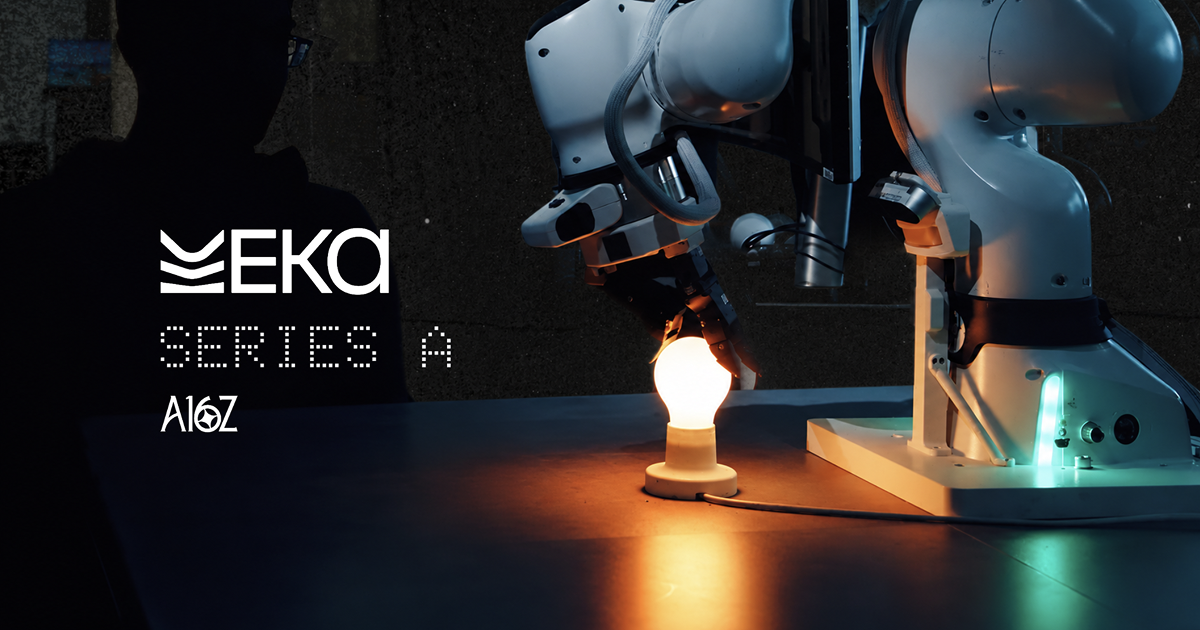
Andreessen Horowitz announced it is leading a Series A investment in Eka Robotics, a startup working on dexterous robot manipulation, the kind of fine hand-and-finger work (gripping, inserting connectors, handling slippery or fragile parts) that structured industrial robots still struggle with. Eka's founders are Pulkit Agrawal, a robot-learning researcher at MIT CSAIL, and Tuomas Haarnoja, co-creator of the Soft Actor-Critic reinforcement learning algorithm who previously worked at Google DeepMind.
Eka has built what it calls a Vision-Force-Action model that combines visual perception with force feedback from its robotic hands, so the robot uses physical contact itself as information, for example sensing when a grip is slipping or a connector is binding and adjusting instead of simply failing. Rather than training primarily on human demonstrations, Eka trains its manipulation policies largely through reinforcement learning in physics simulation, letting virtual robots practice huge numbers of variations before deploying to real hardware.
According to a16z's announcement, Eka reports up to 1,500 picks per hour in laboratory induction and bin-picking tasks, which it says is about two and a half times faster than human workers at the same tasks. a16z frames the investment as a bet that scaling simulation-trained dexterity, rather than hand-tuned automation, can expand robots into much larger categories of physical work.
Why it matters
Dexterous manipulation is one of the biggest remaining barriers to automating physical work, and this funding signals strong investor confidence in the simulation-based approach to solving it.
Source: Andreessen Horowitz